
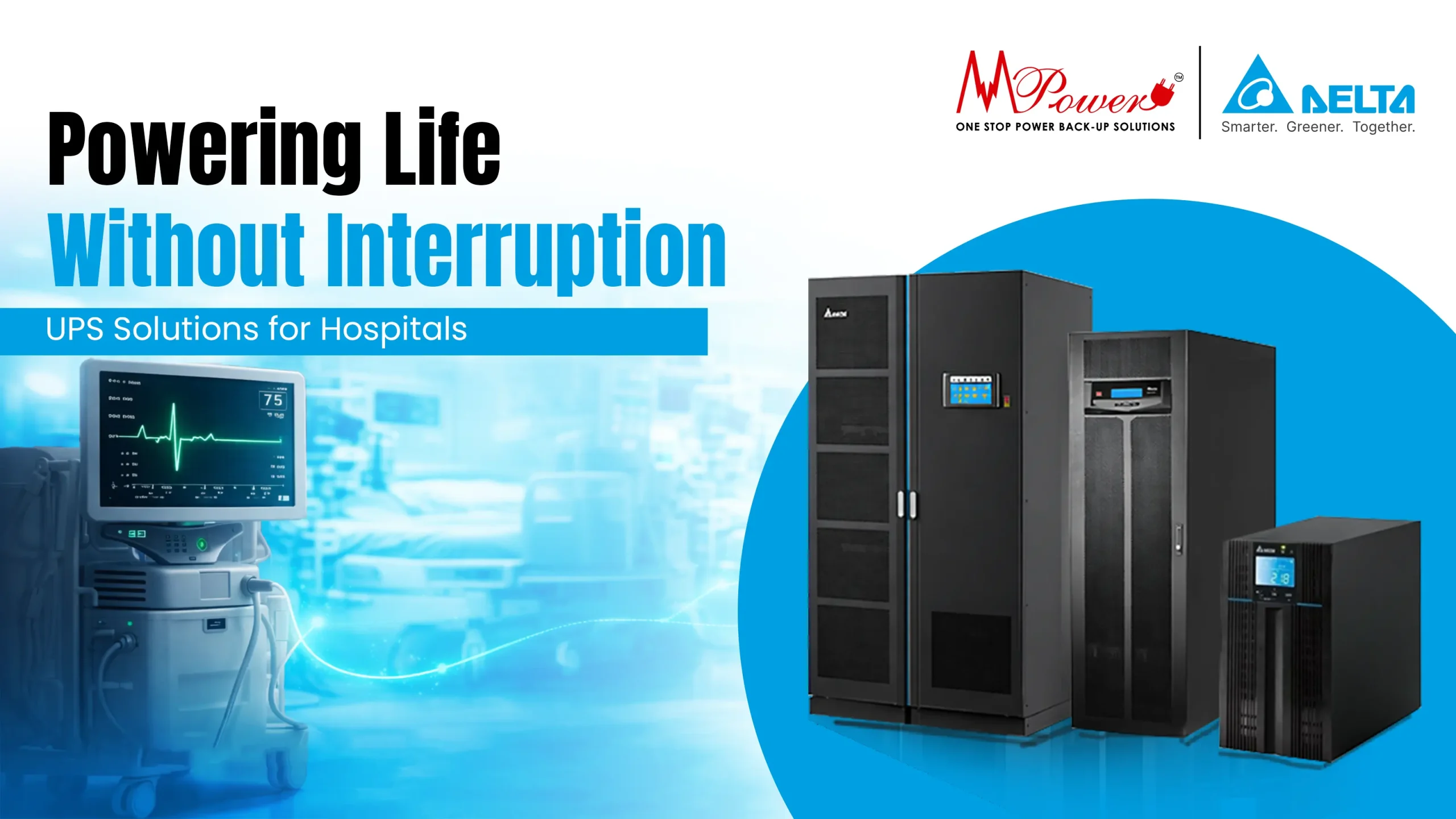
Hospitals operate in an environment where power stability directly affects human life. Unlike commercial buildings, a power interruption in a healthcare facility does not only stop operations – it can stop treatment. Ventilators, infusion pumps, surgical lighting, imaging systems, and patient monitoring devices all require continuous and clean electricity.
Because of this, healthcare infrastructure depends on specially engineered UPS for hospitals that provide instantaneous backup, voltage conditioning, and electrical isolation. These systems are not ordinary backup devices; they are medical-grade power protection systems designed to maintain patient safety and equipment accuracy during outages and electrical disturbances.
MPower deploys hospital-grade UPS solutions that match clinical criticality levels, ensuring each department receives the correct level of protection and runtime support.
Power Challenges Inside a Hospital Environment
Hospitals face more complex electrical conditions than typical buildings. Apart from outages, they frequently experience voltage dips, harmonic distortion from imaging equipment, and sudden load variation when machines start.
Medical equipment is extremely sensitive to such disturbances. Even a 10–20 millisecond interruption can reboot monitoring systems or interrupt a surgical procedure. Similarly, voltage fluctuation can alter diagnostic readings in imaging and laboratory equipment.
A properly engineered UPS for hospitals eliminates these risks by isolating medical devices from raw utility power and continuously supplying stabilized output.
Critical Hospital Areas Requiring Dedicated UPS Protection
Not every hospital department requires the same runtime or configuration. A well-designed UPS for hospitals separates loads based on criticality level.
Life-Support Critical Loads
ICU ventilators, patient monitors, infusion pumps
Required: Zero interruption + high reliability redundancy
Surgical Critical Loads
Operation theatre lights, anesthesia machines, surgical equipment
Required: Clean power + continuous runtime until generator start
Diagnostic Equipment
MRI, CT scan, X-ray, laboratory analyzers
Required: Stable voltage and harmonic filtering
IT & Communication Systems
Hospital management systems, nurse stations, servers
Required: Data integrity and continuous operation
MPower structures hospital UPS distribution so each category receives tailored protection instead of a single oversized system.
Advantages of a Properly Engineered Hospital UPS
When correctly implemented, UPS for hospitals infrastructure improves both safety and operational efficiency. Equipment operates under stable conditions, reducing calibration errors and maintenance frequency. Doctors receive consistent readings, surgeries proceed safely, and patient monitoring continues without disruption.
Hospitals also protect high-value diagnostic machines from electrical stress, significantly extending equipment lifespan and reducing unexpected repair costs.
MPower’s Role as a Healthcare Power Partner
Healthcare facilities require more than product supply – they require reliability assurance. MPower designs customized UPS for hospitals by studying department-wise load behavior, required runtime, redundancy levels, and future expansion capacity.
From planning and installation to periodic maintenance and battery management, the focus remains on ensuring the system performs perfectly during real emergencies. This lifecycle approach allows hospitals to operate confidently, knowing that power continuity is professionally managed.