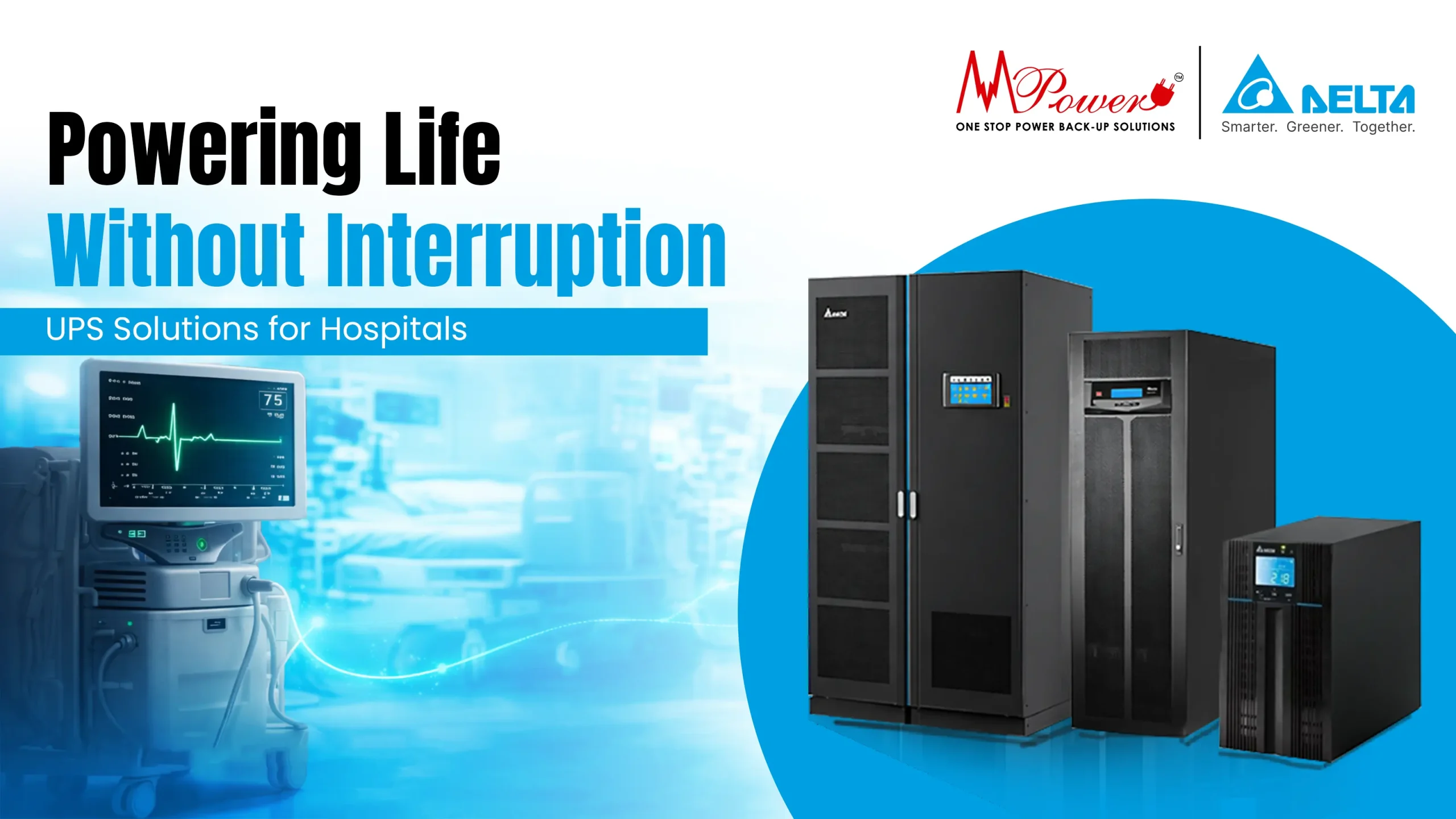
A hospital UPS system provides immediate and conditioned electrical power for selected medical equipment, clinical departments and healthcare IT when the utility supply fails or becomes unstable. It bridges the period before the emergency generator starts, while also helping protect sensitive electronic loads from voltage variation, frequency disturbance, electrical noise and unexpected shutdown.
MPower India supplies online UPS for hospitals across multiple capacity ranges, including compact single-phase systems, three-phase UPS installations and modular UPS configurations. The recommended design depends on the exact equipment list, connected load, inrush current, required backup duration, redundancy, generator behaviour, battery space and the medical equipment manufacturer’s electrical requirements.
- Clinical load assessmentICU, operation theatre, diagnostic, laboratory, communication and IT loads are classified separately.
- 1 kVA to 200 kVA and scalable optionsMPower’s Delta UPS range supports small departmental loads through large centralised hospital requirements.
- Battery, bypass and generator coordinationRuntime, battery charging, maintenance bypass and generator compatibility are planned as one system.
- Lifecycle supportSelection, supply, installation, commissioning, monitoring, preventive maintenance and UPS AMC can be included.
What Is a Hospital UPS System?
A hospital UPS system is an uninterruptible power supply installation designed to maintain protected power for selected healthcare loads during mains failure and to improve the quality of electricity supplied to sensitive electronic equipment. Depending on the project, the solution may include the UPS, batteries, input and output panels, maintenance bypass, distribution, remote monitoring, battery monitoring and integration with the hospital’s generator or building-management system.
A UPS does not replace the complete hospital emergency-power system. A generator may provide longer-duration backup, while the UPS responds immediately and supports critical loads during the generator’s starting and stabilisation period. The UPS for hospital applications must therefore be coordinated with the generator, automatic changeover arrangement, distribution system and each connected device.
Why Hospitals Need Reliable UPS Power Protection
Hospitals contain a mixture of electronic, electromechanical, diagnostic, communication and IT loads. Each category behaves differently during a power disturbance. Some devices must continue operating without interruption, some require stable voltage and frequency, while others need enough runtime for a controlled shutdown or safe completion of an ongoing process.
Utility failure is not the only concern. Voltage sags, overvoltage, frequency variation, line noise, generator changeover disturbance and sudden load changes can affect electronic systems. An engineered hospital power backup system helps isolate selected critical loads from these disturbances and reduces the risk of abrupt shutdown, data loss, interrupted workflow or equipment malfunction.
Bridges generator start-up
The UPS supplies power immediately when mains power fails, helping maintain selected loads while the generator starts and reaches stable operating conditions.
Conditions sensitive loads
Online UPS technology can provide regulated output and reduce exposure to common utility and generator-side electrical disturbances.
Supports clinical continuity
Department-specific protection helps healthcare teams continue essential activities or complete controlled procedures during a power event.
Protects hospital IT
Servers, networks, PACS, hospital information systems and communication platforms can remain available during short interruptions and generator transfer.
Hospital Departments and Equipment That May Require UPS Protection
A strong UPS for hospitals strategy does not place every device on one oversized system. Loads should be grouped according to patient-care importance, equipment behaviour, allowable interruption, required runtime and maintenance needs. The following departments commonly require a technical assessment.
UPS for ICU and patient monitoring
ICU ventilators, monitoring systems, infusion equipment, communication devices and supporting electronics may require high availability, dedicated circuits and carefully planned redundancy. The final connection must be approved by the hospital engineering and biomedical teams.
UPS for operation theatres
Operation theatres can contain surgical lighting, anaesthesia systems, displays, computers, monitoring equipment and supporting electronics. A dedicated online UPS, bypass arrangement and external battery bank may be considered according to the approved electrical design.
UPS for MRI, CT scan and imaging systems
Diagnostic equipment can have specialised inrush, harmonic, power-quality and shutdown requirements. Selection must follow the original equipment manufacturer’s data and should never be based only on the equipment’s nominal kVA label.
UPS for analysers and blood-bank systems
Laboratory analysers, control systems, sample-management computers, refrigeration monitoring and selected test equipment may require protected power to avoid interrupted processing and workflow disruption.
UPS for hospital servers and networks
Hospital information systems, electronic medical records, PACS, servers, storage, switches, telephony and billing systems require dependable power to preserve access to clinical and administrative data.
UPS for communication and security
Nurse-call systems, CCTV, access control, public-address equipment, emergency communication and selected control interfaces may require dedicated UPS protection according to the hospital’s risk assessment.
Why Online Double-Conversion UPS Is Commonly Considered for Hospitals
In an online double-conversion UPS, the connected load is continuously supplied through the UPS power-conversion path during normal operation. When the utility supply fails, the battery-supported inverter continues supplying the load without the transfer delay associated with basic standby architectures. This is why an online UPS for hospitals is commonly considered for sensitive and critical electronic loads.
Online topology can also provide regulated output and help isolate the load from input voltage and frequency problems. For larger hospital installations, features such as dual input, maintenance bypass, parallel operation, N+1 redundancy, remote monitoring and flexible battery configuration can be important.
Topology alone does not guarantee a correct design. The selected UPS must still support the connected equipment’s steady-state load, peak current, overload profile, power factor, harmonic behaviour and required autonomy. The system also needs suitable protection, cabling, earthing, ventilation, bypass and maintenance access.
Hospital UPS Capacity Selection Guide
The table below is an initial planning guide, not a final sizing recommendation. A hospital UPS system should be selected only after a site survey, department-wise load schedule, equipment datasheet review, measured power analysis and redundancy assessment.
| Indicative UPS range | Possible hospital applications | Recommended MPower product family | Selection notes |
|---|---|---|---|
| 1–3 kVA | Individual workstations, small network devices, monitoring interfaces and selected low-power electronic loads | Delta Amplon R Series | Confirm equipment compatibility, real power, socket arrangement and required runtime. |
| 5–20 kVA | Departmental IT, network rooms, grouped workstations, selected laboratory and supporting electronics | Delta Amplon RT Series | Available configurations should be selected according to phase, load and battery requirement. |
| 10–20 kVA | Three-phase-input sites with critical single-phase loads, departmental systems and medical-facility applications | Delta Ultron EH Series | 3-phase input and 1-phase output architecture; assess dual input, bypass and parallel requirements. |
| 20–40 kVA | Larger departments, hospital server rooms, grouped critical loads and dedicated clinical zones | Delta HPH Gen.2 | Compact three-phase UPS with high efficiency, flexible battery quantity and monitoring options. |
| 60–120 kVA | Centralised critical circuits, larger hospital IT environments, diagnostic departments and combined essential loads | Delta Ultron HPH Series | Supports fully rated power, redundancy options, bypass and remote monitoring. |
| 160–200 kVA | High-capacity centralised healthcare infrastructure and large critical-power installations | Delta Ultron HPH 160–200 kVA | Parallel capacity or redundancy may be planned after a complete load and electrical-system study. |
| Modular 20–120 kVA and above | Expanding hospitals, critical IT, scalable infrastructure and N+1 requirements | Delta Modulon DPH Series | Power modules allow staged capacity growth and modular redundancy, subject to system architecture. |
Delta Hospital UPS Systems Available from MPower India
MPower provides a broad Delta UPS portfolio that can support small healthcare departments through large centralised critical-power requirements. The following product families are relevant starting points for a hospital UPS assessment; the final model and configuration must be selected after technical evaluation.
Delta Amplon RT Series 5–20 kVA
The Amplon RT Series is suited to compact critical-power applications such as hospital IT rooms, network systems, departmental electronics and selected clinical support loads. Its high power density can help where rack or floor space is limited.
View the Delta Amplon RT Series →
Delta HPH Gen.2 20–40 kVA
This compact three-phase UPS provides full rated output at 40°C, input power factor of 0.99, low input harmonic distortion, flexible battery quantity and remote monitoring options. It can be evaluated for hospital server rooms, larger departments and grouped critical loads.
View Delta HPH Gen.2 →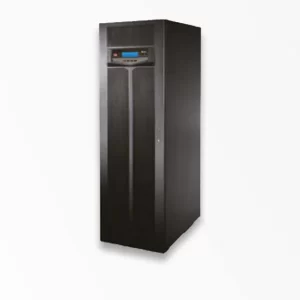
Delta Ultron HPH 60–120 kVA
The Ultron HPH range supports larger mission-critical loads with fully rated power, online double-conversion protection, efficiency up to 96%, low harmonic distortion, high input power factor, built-in bypass and flexible system configurations.
View Delta Ultron HPH 60–120 kVA →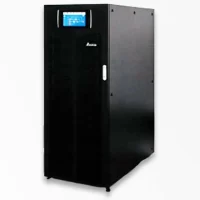
Delta Ultron HPH 160–200 kVA
For high-capacity hospital infrastructure, the HPH 160–200 kVA family provides true online double-conversion protection, high efficiency, low input harmonic distortion and parallel expansion or redundancy options for large critical loads.
View Delta HPH 160–200 kVA →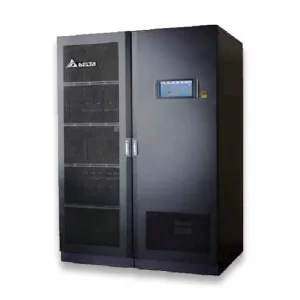
Delta Modulon DPH Modular UPS
A modular hospital UPS system can add capacity through power modules and support redundancy within the same architecture. It may suit expanding healthcare facilities, critical hospital IT and projects where staged growth and maintainability are priorities.
View Delta Modulon DPH →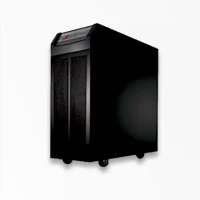
Delta Ultron EH 10–20 kVA
The Ultron EH Series is designed for IT rooms, telecommunications, banking, medical facilities and industrial applications. Its online double-conversion topology, dual input, built-in manual bypass and parallel capability make it relevant where three-phase supply feeds critical single-phase loads.
View Delta Ultron EH Series →Hospitals with smaller loads can also evaluate the Delta Amplon R Series 1–3 kVA online UPS. For the complete portfolio, visit MPower’s Delta online UPS range.
How to Size a Hospital UPS System Correctly
Correct sizing is the most important step in building a dependable hospital UPS system in India. Oversizing increases capital cost, battery cost and operating losses, while undersizing can cause overload or insufficient runtime during the exact event the system is expected to manage.
- Prepare a department-wise equipment listRecord equipment name, quantity, rated voltage, current, watts, VA, power factor, operating mode and whether all units run simultaneously.
- Classify criticalitySeparate life-support critical, procedure-critical, diagnostic, IT, communication, essential and non-critical loads. This prevents lower-priority equipment from reducing autonomy for essential systems.
- Measure real operating loadUse verified electrical data or power measurements where possible. Nameplate values alone may not show actual peak demand, start-up current or harmonic behaviour.
- Check inrush and overload requirementsDiagnostic, motor-driven and electromechanical equipment can draw temporary peak current. Confirm whether the UPS can support these peaks and whether bypass operation is permitted.
- Confirm power factor and phase configurationDetermine whether the protected load is single-phase or three-phase and whether the selected UPS output power in kW supports the real load.
- Define backup durationRuntime should cover generator starting and stabilisation, continued clinical operation or a controlled shutdown. Different departments may need different battery autonomy.
- Plan redundancy and maintainabilityCritical loads may require parallel units, N+1 modules, dual input, maintenance bypass, redundant distribution or a segregated architecture.
- Include justified future growthAccount for planned wards, diagnostic systems, IT expansion and additional equipment without adding an excessive and inefficient margin.
Single-Phase, Three-Phase and Modular UPS for Hospitals
Single-Phase Online UPS
A single-phase online UPS may be suitable for individual medical-support devices, workstations, network equipment, laboratory electronics and smaller departmental loads. Compact rack or tower designs can simplify deployment in IT rooms and limited spaces, but the output capacity and socket or distribution arrangement must match the actual load.
Three-Phase Hospital UPS
A three-phase UPS for hospitals is commonly considered for larger departments, centralised critical circuits, diagnostic areas, hospital data infrastructure and facilities where three-phase distribution is available. Depending on the model, the system may use three-phase input with single-phase output or three-phase input and output.
Modular UPS for Hospitals
A modular UPS contains multiple power modules within one system. Capacity can be expanded by adding modules, and N+1 redundancy can be designed by installing one additional module beyond the active load requirement. This can improve maintainability and provide a structured growth path for expanding hospitals, subject to correct system architecture and spare-module strategy.
| UPS architecture | Typical strengths | Suitable starting point | Important checks |
|---|---|---|---|
| Single-phase online | Compact, suitable for smaller dedicated loads and departmental IT | Workstations, networks, selected electronics | Output phase, real power, runtime and equipment compatibility |
| Three-phase online | Higher capacity, centralised protection, parallel options | Larger departments, IT rooms and combined critical loads | Input/output architecture, generator compatibility and bypass design |
| Modular online | Scalable capacity, module-level redundancy and easier staged growth | Expanding hospitals and high-availability infrastructure | Initial frame size, N+1 plan, spare modules, battery design and maintenance procedure |
Hospital UPS and Generator Coordination
Hospitals typically use both a UPS and a diesel generator because the two systems perform different functions. The UPS responds immediately and supplies the protected load through short interruptions and changeover. The generator provides longer-duration emergency power after starting and stabilising.
A generator should not be selected independently of the UPS. The design team must consider generator capacity, voltage regulation, frequency stability, step-load response, UPS input power factor, input harmonic distortion and battery-recharge demand. A generator that appears large enough for the load may still behave poorly if the combined UPS input and charging demand are not considered.
Generator sizing
Review active load, UPS losses, battery charging, other emergency loads and allowable generator utilisation.
Changeover behaviour
Confirm the automatic changeover sequence, stabilisation time and how the UPS responds to generator voltage and frequency.
Harmonic performance
Low UPS input harmonic distortion and high input power factor can improve compatibility with upstream electrical infrastructure.
Battery recharge control
Charging current may need coordination so that the generator is not overloaded after a prolonged outage.
Hospital UPS Battery and Backup-Time Planning
Battery autonomy must be calculated from the actual connected load, battery system, UPS efficiency and required runtime. It should not be estimated only from the UPS kVA rating. A lightly loaded 100 kVA system and a heavily loaded 100 kVA system can provide very different backup times using the same battery bank.
For many hospital applications, the battery only needs to bridge generator start-up and stabilisation. Other loads may require extended runtime because the clinical process cannot stop immediately, generator availability is uncertain or a controlled shutdown takes longer. This decision should be made department by department.
Battery-planning factors
- Actual connected load in kW
- Required autonomy at present and future load
- Approved battery type and battery quantity
- Number of parallel battery strings
- Ambient temperature and ventilation
- Battery ageing and replacement assumptions
- Available battery room, rack or cabinet space
- Monitoring and individual block health requirements
- Generator start-up and stabilisation period
- Charging-current and recharge-time requirements
MPower provides UPS battery solutions and can support battery sizing, replacement and maintenance as part of the complete hospital power-backup project.
Standards and Engineering Considerations for Hospital UPS Projects
A hospital UPS installation should be designed and approved by qualified professionals according to applicable Indian regulations, hospital engineering policies, consultant specifications, medical-equipment manufacturer instructions and relevant electrical standards. The UPS is only one part of a broader medical-location electrical installation.
This standard addresses low-voltage electrical installations in medical locations, including hospitals and clinics, with requirements intended to support the safety of patients and medical staff. Project consultants should determine how its requirements and applicable Indian standards affect the facility design.
View the official IEC publication →This standard establishes methods for specifying performance and test requirements for complete electronic uninterruptible power systems. It is relevant when evaluating UPS performance classification and test criteria.
View the official IEC publication →Additional requirements may apply to medical isolation systems, earthing, residual current protection, fire safety, battery rooms, ventilation, electromagnetic compatibility, equipment-specific electrical supply and local statutory approvals. MPower’s UPS recommendation should be integrated into the final design prepared and approved by the project’s authorised electrical and healthcare consultants.
Hospital UPS Installation, Commissioning and AMC
A high-quality UPS can still underperform if the installation is poorly designed. A professional hospital UPS installation should account for cable sizing, breakers, selectivity, earthing, input and output panels, maintenance bypass, battery protection, ventilation, floor loading, service clearance, environmental conditions and safe access.
Site survey and load study
Review protected loads, existing electrical distribution, generator details, available space, operating environment and future expansion.
UPS and battery selection
Select capacity, topology, battery autonomy, redundancy, bypass, communication and monitoring according to the approved requirement.
Installation and commissioning
Coordinate equipment placement, cables, protection, battery system, testing, start-up, alarms and handover documentation.
Hospital UPS AMC
Plan preventive inspections, battery health checks, alarm review, cleaning, measurements, testing and emergency support.
Preventive maintenance should check more than whether the UPS is “ON”
A hospital UPS may appear normal while its battery capacity has degraded, fans are blocked, connections are loose or the system is operating close to overload. Planned preventive maintenance can include visual inspection, input/output measurements, load review, battery voltage and impedance checks, alarm-history analysis, bypass checks, cooling inspection, cable and terminal inspection and backup-time verification.
MPower provides UPS AMC services in Mumbai and across India, including preventive maintenance, emergency support, battery replacement, repairs and service for critical power-backup installations.
Why Choose MPower India for Hospital UPS Solutions?
Hospital power protection is an engineering and lifecycle responsibility, not only a product purchase. MPower India supports healthcare facilities with a broad Delta UPS portfolio, batteries, installation coordination, preventive maintenance and AMC services. The company’s existing project material also identifies healthcare organisations among its served customers, demonstrating experience with critical institutional environments.
Complete Delta UPS range
Single-phase, three-phase and modular online UPS systems across small, medium and high-capacity requirements.
Application-based selection
Recommendations consider department criticality, equipment behaviour, runtime, redundancy and generator integration.
Battery and electrical integration
Support can include battery sizing, bypass, panels, monitoring, installation and commissioning coordination.
Lifecycle support
Preventive maintenance, battery replacement, repairs and annual maintenance contracts help protect long-term availability.
Request a Hospital UPS System Assessment
Share your hospital location, protected equipment list, estimated connected load, required backup duration, electrical phase, generator details and redundancy requirement. MPower can help evaluate a suitable online or modular UPS architecture and prepare a project-specific quotation.
Frequently Asked Questions About Hospital UPS Systems
What type of UPS is best for a hospital?
An online double-conversion UPS is commonly considered for sensitive and critical hospital loads because it continuously conditions power and has no transfer interruption between normal and battery operation. The final topology, capacity and redundancy must be selected according to the connected equipment, clinical criticality and approved hospital electrical design.
Why do hospitals need both a UPS and a generator?
A UPS provides immediate backup when utility power fails, while a generator normally takes time to start and stabilise. The hospital UPS system bridges this period and can also provide conditioned power to selected sensitive loads. The generator then supports longer-duration emergency operation.
Which medical equipment should be connected to a UPS?
Depending on the facility, protected loads may include selected ICU systems, operation-theatre equipment, laboratory electronics, diagnostic support systems, servers, networks, communication and security infrastructure. The medical equipment manufacturer, hospital biomedical team, electrical consultant and facility engineering team should approve the final connection.
Can a UPS be used for MRI and CT scan equipment?
It may be possible, but MRI and CT systems can have specialised inrush, harmonic, grounding, shutdown and power-quality requirements. A UPS for MRI or CT scan equipment must be selected from the manufacturer’s detailed electrical specifications and a professional power study, not only the nominal equipment rating.
How is hospital UPS capacity calculated?
Capacity is calculated from the total protected load, real power in kW, apparent power in kVA, power factor, simultaneous operation, peak current, overload profile, future growth and required redundancy. Battery capacity is calculated separately from the actual load and required backup duration.
How much backup time should a hospital UPS provide?
Required runtime depends on the generator start-up and stabilisation period, clinical criticality, outage strategy and time needed to continue operation or complete a controlled shutdown. Different departments may need different battery autonomy, so one standard runtime should not automatically be applied to the entire hospital.
Can one UPS power an entire hospital?
A centralised UPS can support selected critical circuits when correctly engineered, but connecting every hospital load to one UPS may be impractical and inefficient. Many facilities segregate clinical, diagnostic, IT and communication loads according to criticality and use multiple UPS systems or distribution groups.
What is N+1 redundancy in a hospital UPS system?
N+1 means the system has one additional UPS unit or power module beyond the capacity required to support the active load. If one module is unavailable, the remaining capacity can continue supporting the load, provided the system has been correctly sized and configured.
What information is required for a hospital UPS quotation?
Provide the equipment list, quantity, rated power, measured load where available, electrical phase, required runtime, generator capacity, site location, available space, redundancy requirement and planned future expansion. Diagnostic equipment datasheets and a single-line diagram are especially useful.
Does MPower provide hospital UPS installation and AMC?
MPower supports UPS selection, supply, battery sizing, installation and commissioning coordination, preventive maintenance, battery replacement, repairs and UPS AMC services. The exact project scope and response coverage should be confirmed in the commercial proposal.